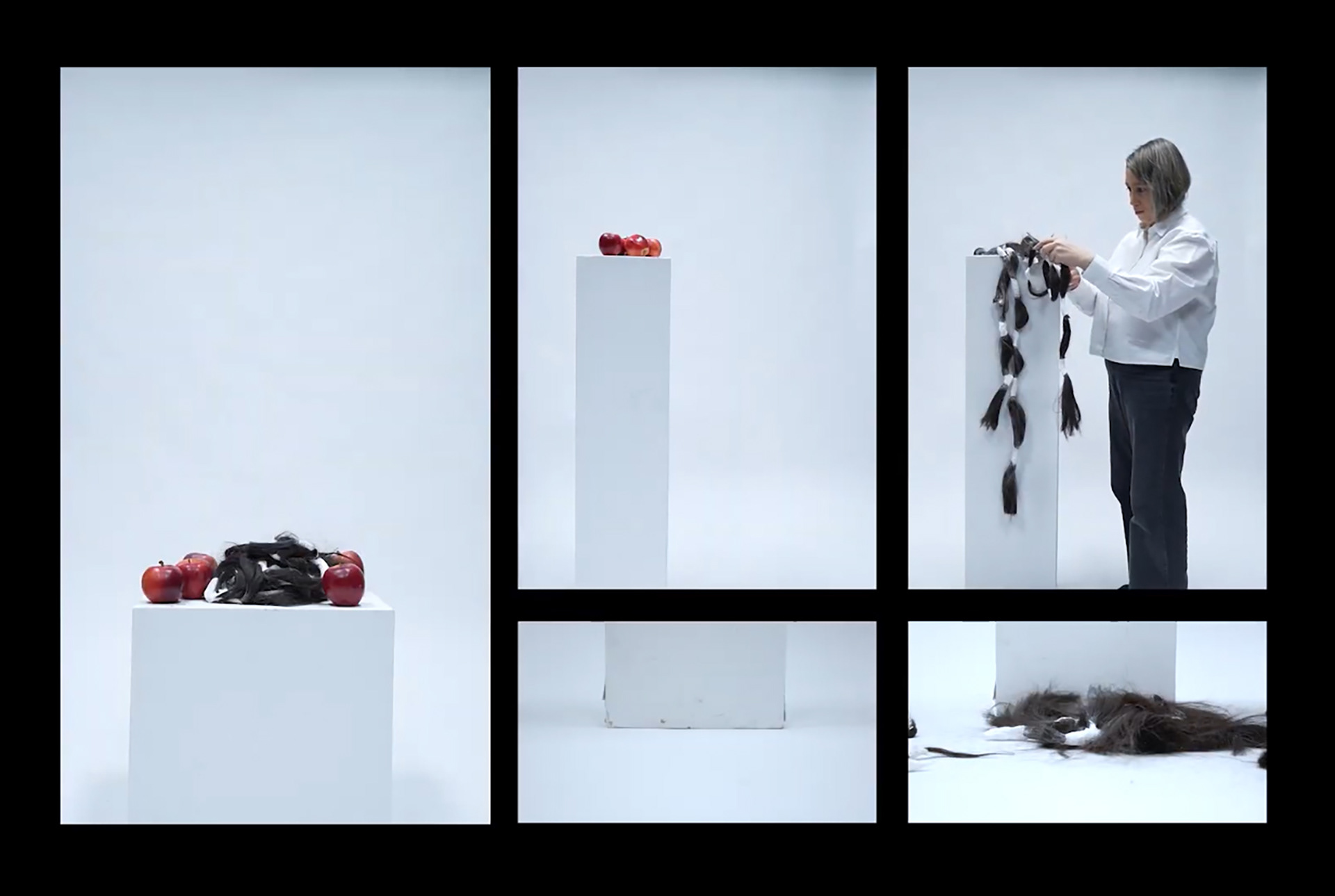
She thinks I’m a sinner, 2025, 7:55.
hair-bone, plaster, real hair.
When I lost my father eight years ago, I encountered death for the first time. Death, in turn,
reminded me of life. I asked myself: What am I going to do with the rest of my life?
I want to live the life I had at six—before I understood the constraints of gender, before I learned
how I was expected to perform as a woman in society. I want to unlearn these restrictions, to
break free from the roles imposed on me.
There is no easy path to healing except through understanding and unraveling my past. I felt
ashamed—of my history, my country, myself. But death constantly pulled me back to my past,
urging me to confront and rediscover myself—who I am, my identity. Shame does not belong to
me; it belongs to the oppressor.
Through my work, I weave storytelling into the objects I create and the ready-made elements I
incorporate—like apples or a suitcase—transforming them into vessels for navigating memory,
resistance, and self-discovery in video.
hair-bone, plaster, real hair.
When I lost my father eight years ago, I encountered death for the first time. Death, in turn,
reminded me of life. I asked myself: What am I going to do with the rest of my life?
I want to live the life I had at six—before I understood the constraints of gender, before I learned
how I was expected to perform as a woman in society. I want to unlearn these restrictions, to
break free from the roles imposed on me.
There is no easy path to healing except through understanding and unraveling my past. I felt
ashamed—of my history, my country, myself. But death constantly pulled me back to my past,
urging me to confront and rediscover myself—who I am, my identity. Shame does not belong to
me; it belongs to the oppressor.
Through my work, I weave storytelling into the objects I create and the ready-made elements I
incorporate—like apples or a suitcase—transforming them into vessels for navigating memory,
resistance, and self-discovery in video.